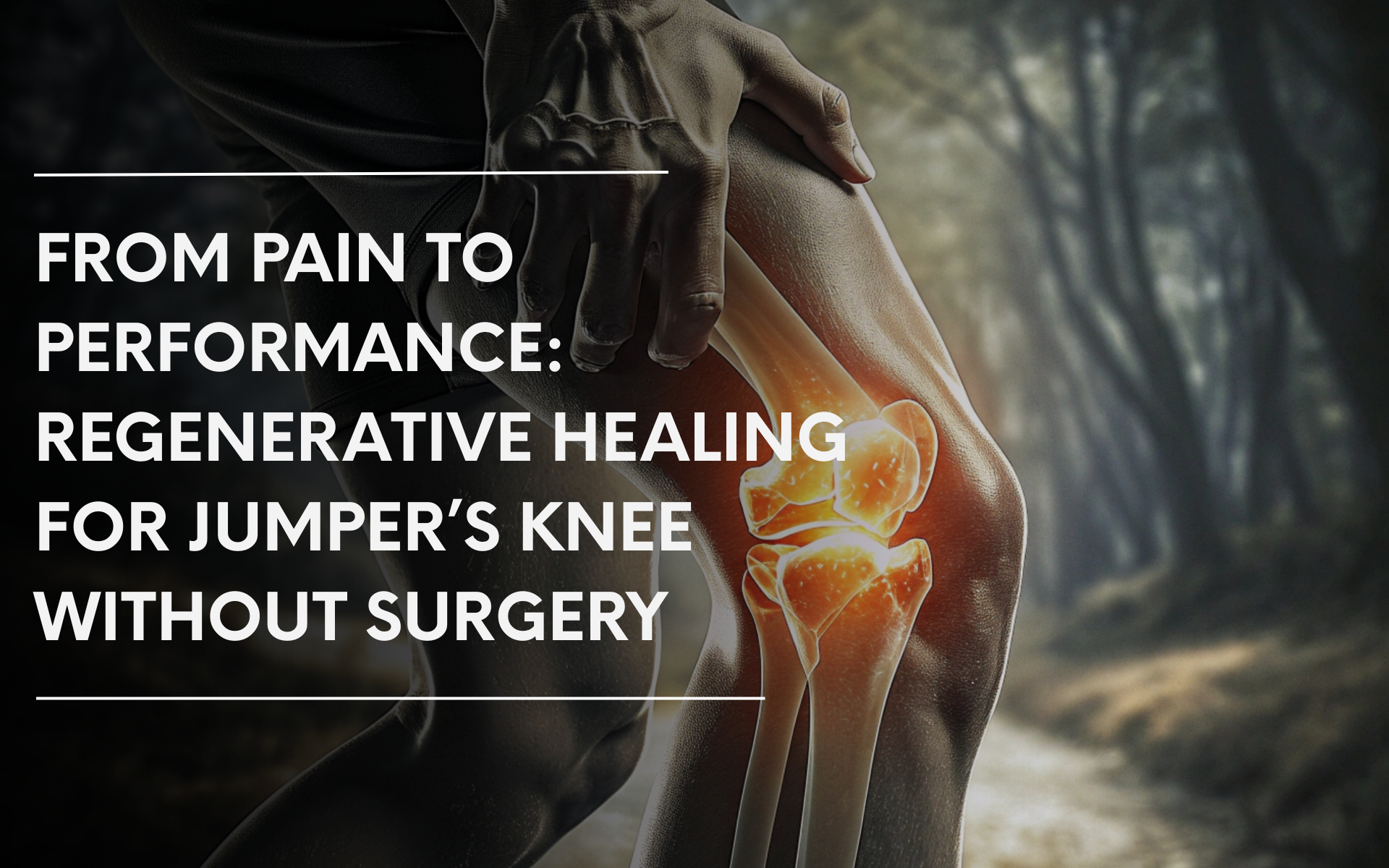
From Pain to Performance: Regenerative Healing for Jumper’s Knee Without Surgery
A common problem for athletes and physically active people is knee pain, frequently brought on by overuse and repetitive strain. Jumper’s knee, also known as patellar tendinopathy, is a degenerative condition of the patellar tendon that is very common in this group and can seriously affect quality of life and performance.
Jumper’s knee treatment has historically centered on managing symptoms with rest, medicine, or, in extreme situations, surgery. But thanks to developments in regenerative medicine, real tissue repair can now be encouraged without requiring surgery. Our specialty at Orthobiologix Clinic uses biologic therapies to help patients resume pain-free activities, restore function, and promote natural tendon healing.
Understanding Jumper’s Knee
The tendon that connects the kneecap (patella) to the shinbone (tibia) is painful and dysfunctional in patellar tendinopathy. Repetitive jumping, running, or sudden direction changes—activities typical of sports like basketball, volleyball, football, and athletics—are usually the cause of the condition.
Microtears in tendon fibers due to excessive strain and insufficient recovery are the pathology. Instead of causing acute inflammation, these repeated injuries cause collagen disarray, tendon thickening, and tissue degeneration over time. The condition frequently experiences the following stages as it advances:
The tendon that connects the kneecap (patella) to the shinbone (tibia) is painful and dysfunctional in patellar tendinopathy. Repetitive jumping, running, or sudden direction changes—activities typical of sports like basketball, volleyball, football, and athletics—are usually the cause of the condition.
Microtears in tendon fibers due to excessive strain and insufficient recovery are the pathology. Instead of causing acute inflammation, these repeated injuries cause collagen disarray, tendon thickening, and tissue degeneration over time. The condition frequently experiences the following stages as it advances:
Stage 1: Intense pain after physical activity
Stage 2: Pain during and before activity, but does not limit performance
Stage 3: Daily activities or athletic non-performance due to persistent pain
Stage 4: Partial tendon rupture and degenerative changes
Pain at the lower border of the patella, tenderness when palpated, stiffness after rest, and decreased strength in the affected leg are usually noticed.
Constraints of Traditional Therapy
Jumper’s knee is typically treated with rest, physiotherapy, corticosteroid injections, and non-steroidal anti-inflammatory medications (NSAIDs). Although these actions can offer short-term respite, they hardly ever lead to long-term healing.
Although immobilization and rest can lessen pain, they frequently cause muscle weakness and slow tendon healing.
Regular intake of NSAIDs may be prescribed, but ideally, they do not aid in tendon repair. Corticosteroids mainly reduce inflammation and pain; in fact, they may even weaken tendon tissue.
Surgical intervention, usually chosen for prolonged or severe cases, involves tendon debridement or repair. It has inherent risks, such as infection, the formation of scar tissue, and prolonged rehabilitation, even though it works for some people.
Biologics for Jumper’s Knee
PRP or Platelet-Rich Plasma
A tiny amount of the patient’s blood is extracted for PRP therapy, and the platelets and growth factors are separated through processing. Under image guidance, the concentrated plasma is injected straight into the injured patellar tendon.
Bioactive proteins and cytokines released by platelets encourage:
Tendon regeneration and collagen synthesis
Decrease in persistent inflammation
Formation of new blood vessels (angiogenesis)
Enhanced cellular communication for tissue repair
According to clinical research, PRP, especially when given early in the course of the disease, can dramatically reduce pain and improve function in patients with chronic patellar tendinopathy.
Stem Cell Therapy
Stem cell therapy provides an even more potent regenerative strategy for patellar tendinopathy that is more severe or recurrent. The patient’s own bone marrow or adipose (fat) tissue is used to create stem cells, which have the amazing ability to proliferate and differentiate into a variety of cell types.
These cells release growth factors and healing signals when they are introduced into a damaged tendon. These include:
- Encourage tendon fiber repair
- Lessen inflammation
- Prevents scar tissue
- Boosts the resilience and elasticity of your tendons
Instead of directly replacing tissue, stem cells coordinate the body’s healing process, enhancing the biological milieu and encouraging long-lasting recovery. For patients who want to achieve long-lasting function restoration without surgery, this natural, autologous (self-derived) therapy offers an alternative.
The Orthobiologix Approach
At Orthobiologix Clinic, we employ a comprehensive process for regenerative management of jumper’s knee.
Step 1: Thorough Assessment – Every patient has a thorough evaluation that includes clinical evaluation of flexibility, pain location, and movement. This could also include diagnostic imaging to evaluate tendon integrity, such as MRI or ultrasound.
Step 2: Customized Treatment Programs – Depending on the severity and stage of tendinopathy, a personalized biologic therapy plan is created. For best healing, PRP, stem cell therapy, or a mix of the two may be used in the treatment.
Step 3: Monitoring and Follow-Up – Regular imaging evaluations and follow-up consultations aid in monitoring the healing process. To strengthen the regenerative effect, more sessions might be suggested based on progress.
Benefits of Regenerative Medicine
- Minimally invasive: No surgical incision or anesthesia is necessary.
- Repairing the root cause: Instead of reducing symptoms, root-cause repair addresses tendon degeneration.
- Quick recovery: Within weeks, patients can return to light activities.
- Long-lasting effects: Encourages natural tissue regeneration for relief that lasts.
- Utilizing the patient’s own cells reduces the possibility of rejection and is safe and biocompatible.
In conclusion
Jumper’s knee can severely limit an active lifestyle, but regenerative medicine has revolutionized the way we treat it. Without surgery, patients can regain optimal function and achieve true tendon repair with platelet-rich plasma and stem cell therapy.
Advanced biologic science, clinical knowledge, and a patient-first approach are all combined at Orthobiologix Clinic in Mumbai to provide significant, long-lasting recovery. Early consultation and prompt regenerative intervention can mean the difference between prolonged discomfort and improved performance for people with chronic knee pain or sports-related tendon injuries.
Disclaimer: The information in this article is intended for educational purposes only and should not replace professional medical advice. Please consult a qualified orthopaedic specialist for diagnosis and treatment recommendations.
(KEYWORDS: Knee pain treatment without surgery, Thumb Joint Treatment In Mumbai, Alternatives to knee surgery, Alternatives To knee Surgery, Natural knee pain relief, Symptoms of Chondromalacia Patella, Causes of knee cartilage damage, Why does my kneecap hurt, Knee pain when climbing stairs, PRP therapy knee recovery, Knee pain in young adults, Best treatment for aging knees, Non-surgical options for chronic knee pain, PRP therapy near me, Knee pain clinic near Mumbai, Best regenerative therapy clinic, Knee pain specialist near me, Best regenerative therapy clinic, best orthopaedic in Mumbai, total knee replacement, stem cell therapy for knee, PRP therapy for knee)