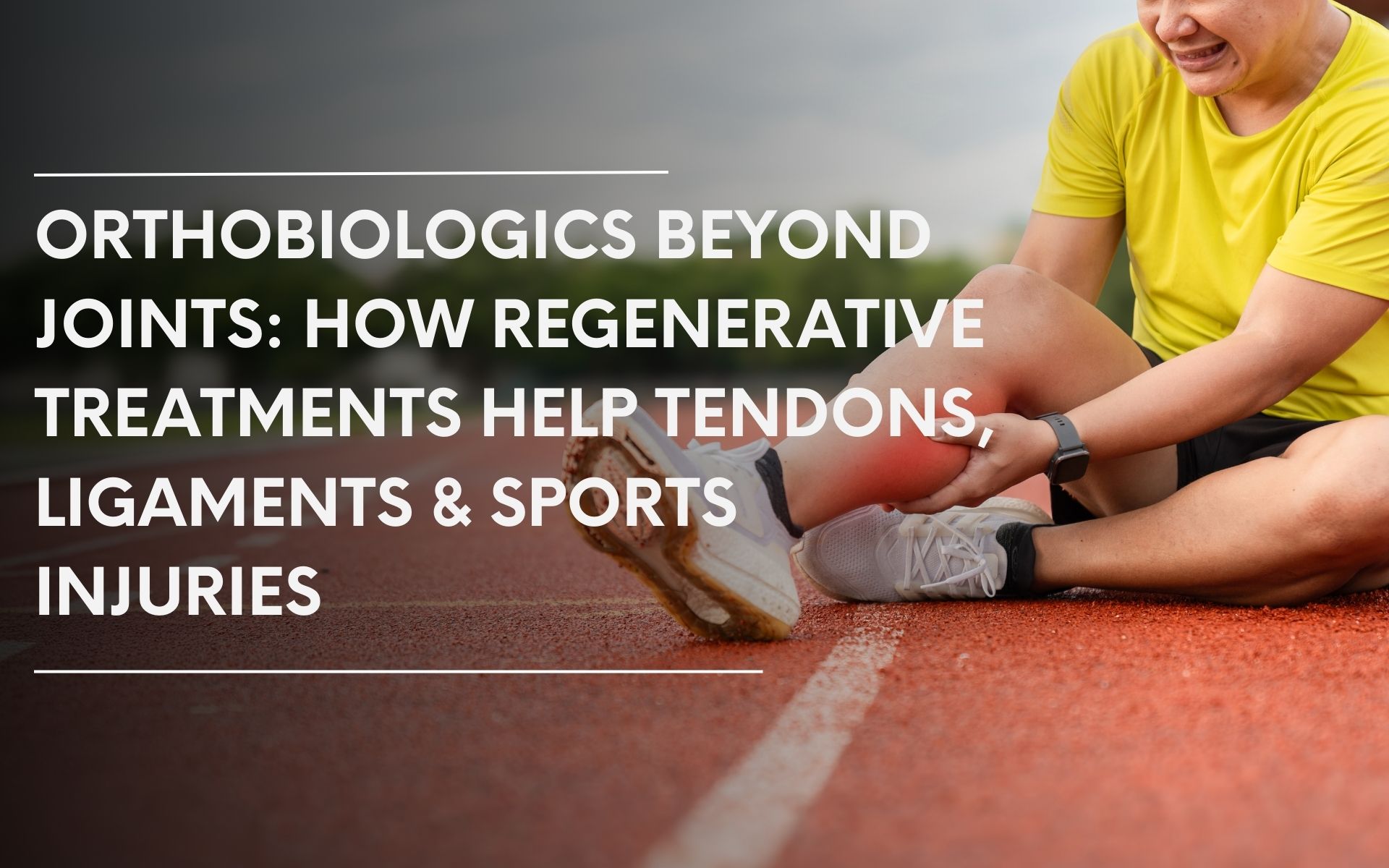
Orthobiologics Beyond Joints: How Regenerative Treatments Help Tendons, Ligaments & Sports Injuries
Musculoskeletal pain is often associated with joints such as the knee, hip, or shoulder. However, a significant number of chronic pain conditions originate not from the joint itself, but from the surrounding soft tissues—tendons and ligaments—that support movement and stability. These structures play a critical role in everyday mobility and athletic performance, yet they are particularly vulnerable to injury and slow to heal.
Orthobiologics has expanded the understanding of regenerative medicine beyond joint-related conditions, offering non-surgical solutions for tendon, ligament, and sports-related injuries. Through regenerative care such as Platelet Rich Plasma and Stem Cell Treatment, attention has shifted from managing symptoms to facilitating the body’s own healing.
Understanding Tendon and Ligament Injuries
Since muscles have a rich blood supply, tendons and ligaments lack adequate blood supply and take longer to heal. The end result is that injuries to tendons and ligaments often become chronic, leading to pain, stiffness, weakness, and decreased mobility. Tennis elbow, Achilles tendinopathy, Rotator cuff injuries, and ligament sprains are common complaints that often do not respond to rest and conventional pain management methods.
It is here that regenerative orthobiologics makes a paradigm-shifting difference.
Shifting the Focus From Pain Relief to Healing
Traditional treatments for soft tissue injuries often focus on controlling inflammation or masking pain. While these approaches may offer temporary relief, they do not always address the underlying tissue damage. Regenerative medicine, by contrast, aims to support the body’s inherent capacity to repair and restore damaged tissues.
PRP and stem cell treatments enhance the natural healing environment within injured tendons and ligaments. Rather than relying on mechanical solutions or long-term medication, regenerative therapies encourage biological repair, helping tissues recover in a more sustainable and functional manner.
PRP Therapy: Supporting Natural Repair
PRP has gained recognition as a regenerative option for a wide range of musculoskeletal injuries. The treatment applies components derived from the patient’s own blood to encourage healing of the injury site. When applied to damaged tendons or ligaments, PRP helps stimulate the body’s natural repair response.
What sets PRP apart and gives it its healing benefits is that it encourages tissue regeneration rather than just suppressing inflammation. Over time, this could result in better tissue quality, less pain, and better functional outcomes. Indications for PRP are especially effective for early to moderate tendon injuries and for cases where healing has stalled despite conservative care.
For many patients, PRP is a bridge between physiotherapy and surgery-a minimally invasive option that assists in recovery while preserving natural tissue.
Stem Cell Treatment: Advancing Regenerative Healing
PRP has gained recognition as a regenerative option for a wide range of musculoskeletal injuries. The treatment applies components derived from the patient’s own blood to encourage healing of the injury site. When applied to damaged tendons or ligaments, PRP aids in stimulating the body’s natural repair response.
What sets PRP apart and its healing benefits are that it encourages the regeneration of tissues instead of just suppressing inflammation. With time, this could result in better quality of tissue, less pain, and better functional outcomes. Indications of PRP are especially effective in early to moderate tendon injuries and in cases where healing has stalled despite conservative care.
For many patients, PRP is a bridge between physiotherapy and surgery-a minimally invasive option that assists in recovery while preserving natural tissue.
Regenerative Care for Sports Injuries
In relation to sports, injuries are often associated with either the tendon or ligaments because of the strain or impact incurred by these parts of the body. This could be from overuse by the sports player or the fitness enthusiast.
Regeneratively based treatments must be specifically formulated based on the individual’s condition and goals, and as such, they can be applicable across many sports and activities.
What Healing Looks Like After Regenerative Treatment
Healing following regenerative treatment is a gradual process. Unlike conventional pain-relief methods, results are not immediate but develop over time as tissues repair and strengthen. Patients may notice progressive improvements in pain levels, mobility, and function over weeks to months.
Rehabilitation and guided physical activity often play a complementary role in recovery, allowing regenerated tissues to adapt safely to movement and load. The goal is not only symptom improvement but also long-term tissue resilience and functional restoration.
Patients are encouraged to view regenerative therapy as part of a broader healing journey—one that prioritizes biological recovery, patience, and sustainable outcomes.
Who Can Benefit From Regenerative Orthobiologics?
Regenerative treatments may be suitable for individuals who:
- Experience chronic tendon or ligament pain
- Have sports or overuse injuries that have not healed fully
- Wish to avoid or delay surgery
- Seek long-term improvement rather than temporary relief
- Want to restore mobility and function naturally
A thorough clinical evaluation helps determine whether PRP or stem cell treatment is appropriate, ensuring that care is aligned with the individual’s condition and expectations.
A Broader Vision of Musculoskeletal Healing
Orthobiologics continues to redefine how musculoskeletal injuries are managed by extending regenerative care beyond joints. Tendons and ligaments, though often overlooked, are central to movement, stability, and quality of life. Addressing their healing through regenerative medicine offers a more comprehensive approach to recovery.
By focusing on healing rather than solely on treatment techniques, Orthobiologix Clinic, Mumbai, represents a shift toward patient-centered, biology-driven care. For individuals seeking non-surgical solutions to soft tissue injuries, regenerative orthobiologics offers a path toward lasting recovery, improved function, and renewed confidence in movement.
Disclaimer: The information in this article is intended for educational purposes only and should not replace professional medical advice. Please consult a qualified orthopaedic specialist for diagnosis and treatment recommendations.
KEYWORDS:
regenerative treatment for tendon and ligament injuries, stem cell therapy for tendon healing, PRP treatment for ligament injuries, non-surgical healing for sports injuries, regenerative medicine for soft tissue injuries, PRP therapy for chronic tendon pain, stem cell treatment for ligament damage, how regenerative medicine supports natural healing, healing tendons and ligaments without surgery, regenerative care for sports-related injuries, PRP for long-term tendon recovery, stem cell therapy for chronic sports injuries, regenerative treatments for musculoskeletal healing, natural healing options for tendon and ligament injuries, recovery after regenerative therapy for soft tissue injuries, regenerative medicine for athletes and active individuals, how PRP supports tissue repair and healing, stem cell treatment for non-joint musculoskeletal conditions, biological healing for tendon and ligament degeneration, regenerative orthobiologics for movement restoratio
best regenerative medicine clinic for joint and soft tissue injuries, best PRP treatment center for tendon injuries, best stem cell therapy clinic for sports injuries, best non-surgical treatment for tendon and ligament pain, best orthobiologics clinic for regenerative healing, best PRP therapy for chronic musculoskeletal pain, best stem cell treatment for ligament and tendon recovery, trusted regenerative medicine center for sports injuries, advanced regenerative treatments for pain and mobility restoration, non-surgical regenerative solutions for chronic injuries, personalized regenerative care for musculoskeletal conditions, evidence-based PRP and stem cell treatments for healing, comprehensive regenerative orthobiologics center, regenerative treatments for long-term injury recovery, natural healing-focused regenerative medicine clinic